
Soft Minimalism Georgia O’Keeffe’s Aesthetics of Photographic Personhood
Article Sidebar
Main Article Content
Abstract
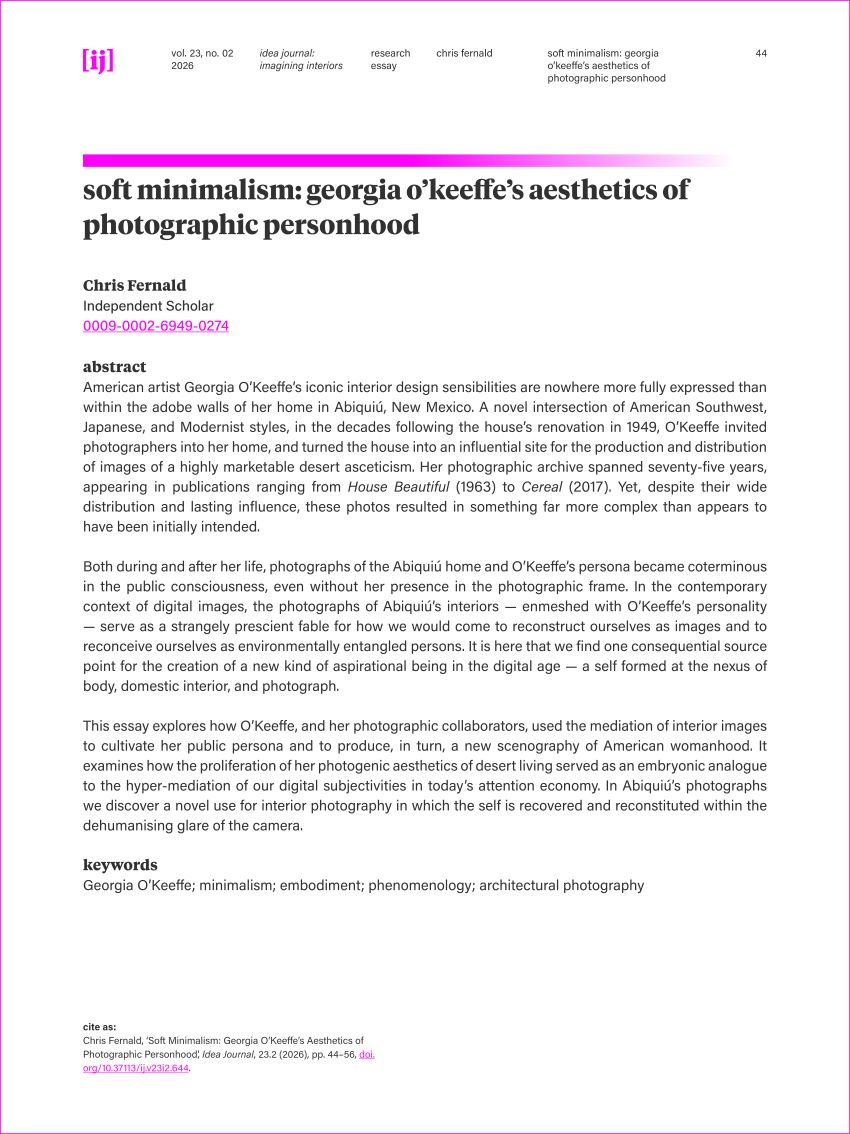
American artist Georgia O’Keeffe’s iconic interior design sensibilities are nowhere more fully expressed than within the adobe walls of her home in Abiquiú, New Mexico. A novel intersection of American Southwest, Japanese, and Modernist styles, in the decades following the house’s renovation in 1949, O’Keeffe invited photographers into her home, and turned the house into an influential site for the production and distribution of images of a highly marketable desert asceticism. Her photographic archive spanned seventy-five years, appearing in publications ranging from House Beautiful (1963) to Cereal (2017). Yet, despite their wide distribution and lasting influence, these photos resulted in something far more complex than appears to have been initially intended.
Both during and after her life, photographs of the Abiquiú home and O’Keeffe’s persona became coterminous in the public consciousness, even without her presence in the photographic frame. In the contemporary context of digital images, the photographs of Abiquiú’s interiors — enmeshed with O’Keeffe’s personality — serve as a strangely prescient fable for how we would come to reconstruct ourselves as images and to reconceive ourselves as environmentally entangled persons. It is here that we find one consequential source point for the creation of a new kind of aspirational being in the digital age — a self formed at the nexus of body, domestic interior, and photograph.
This essay explores how O’Keeffe, and her photographic collaborators, used the mediation of interior images to cultivate her public persona and to produce, in turn, a new scenography of American womanhood. It examines how the proliferation of her photogenic aesthetics of desert living served as an embryonic analogue to the hyper-mediation of our digital subjectivities in today’s attention economy. In Abiquiú’s photographs we discover a novel use for interior photography in which the self is recovered and reconstituted within the dehumanising glare of the camera.
Article Details
Author/s and or their institutions retain copyright ownership over works submitted to Idea Journal, and provide the Interior Design / Interior Architecture Educators Association with a non–exclusive license to use the work for the purposes listed below:
- Make available/publish electronically on the Idea Journal website
- Publish as part of Idea Journal's online open access publications
- Store in electronic databases, on websites and CDs/DVDs, which comprise of post-publication articles to be used for publishing by the Interior Design / Interior Architecture Educators Association.
Reproduction is prohibited without written permission of the publisher, the author/s or their nominated university. The work submitted for review should not have been published or be in the process of being reviewed by another publisher. Authors should ensure that any images used in their essays have copyright clearance.