
this voice; this life; this procession Sensorial Journeys and Entanglements with LiDAR and Kinect in Virginia Woolf’s Writing Room
Article Sidebar
Main Article Content
Abstract
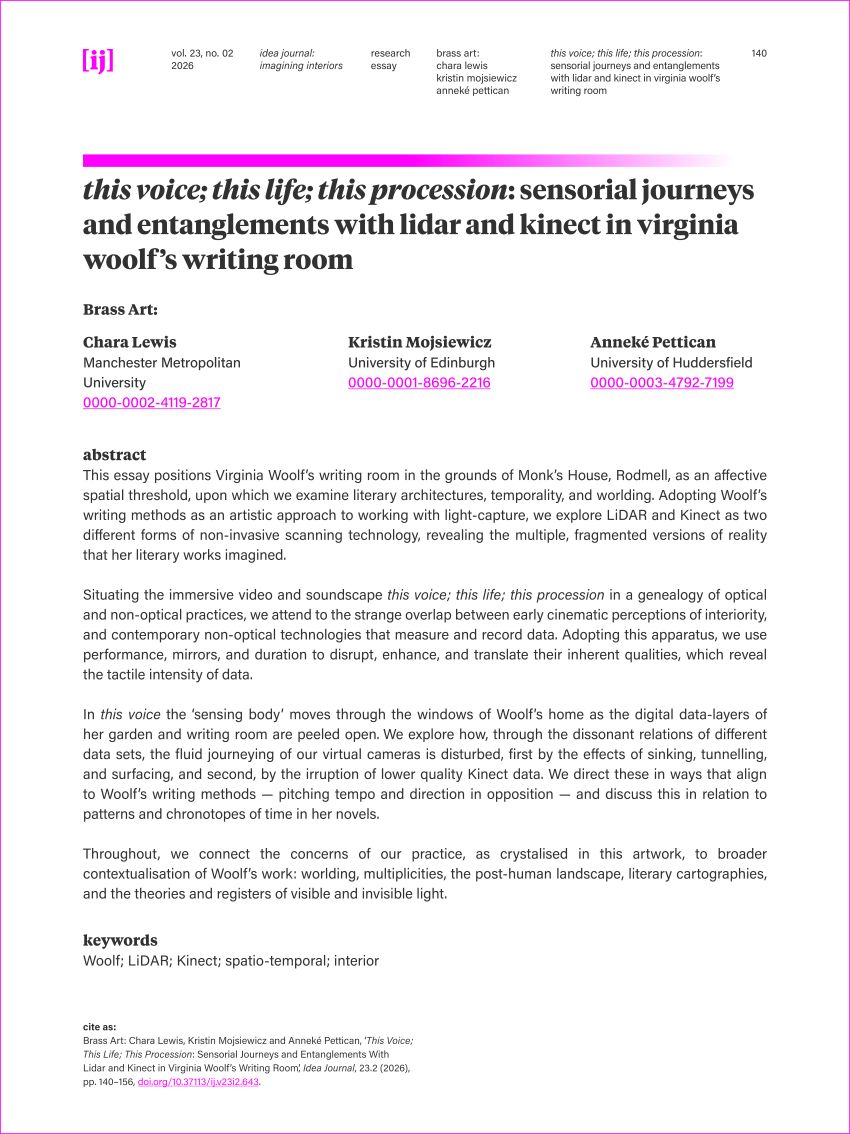
This essay positions Virginia Woolf’s writing room in the grounds of Monk’s House, Rodmell, as an affective spatial threshold, upon which we examine literary architectures, temporality, and worlding. Adopting Woolf’s writing methods as an artistic approach to working with light-capture, we explore LiDAR and Kinect as two different forms of non-invasive scanning technology, revealing the multiple, fragmented versions of reality that her literary works imagined.
Situating the immersive video and soundscape this voice; this life; this procession in a genealogy of optical and non-optical practices, we attend to the strange overlap between early cinematic perceptions of interiority, and contemporary non-optical technologies that measure and record data. Adopting this apparatus, we use performance, mirrors, and duration to disrupt, enhance, and translate their inherent qualities, which reveal the tactile intensity of data.
In this voice the ‘sensing body’ moves through the windows of Woolf’s home as the digital data-layers of her garden and writing room are peeled open. We explore how, through the dissonant relations of different data sets, the fluid journeying of our virtual cameras is disturbed, first by the effects of sinking, tunnelling, and surfacing, and second, by the irruption of lower quality Kinect data. We direct these in ways that align to Woolf’s writing methods — pitching tempo and direction in opposition — and discuss this in relation to patterns and chronotopes of time in her novels.
Throughout, we connect the concerns of our practice, as crystalised in this artwork, to broader contextualisation of Woolf’s work: worlding, multiplicities, the post-human landscape, literary cartographies, and the theories and registers of visible and invisible light.
Article Details
Author/s and or their institutions retain copyright ownership over works submitted to Idea Journal, and provide the Interior Design / Interior Architecture Educators Association with a non–exclusive license to use the work for the purposes listed below:
- Make available/publish electronically on the Idea Journal website
- Publish as part of Idea Journal's online open access publications
- Store in electronic databases, on websites and CDs/DVDs, which comprise of post-publication articles to be used for publishing by the Interior Design / Interior Architecture Educators Association.
Reproduction is prohibited without written permission of the publisher, the author/s or their nominated university. The work submitted for review should not have been published or be in the process of being reviewed by another publisher. Authors should ensure that any images used in their essays have copyright clearance.